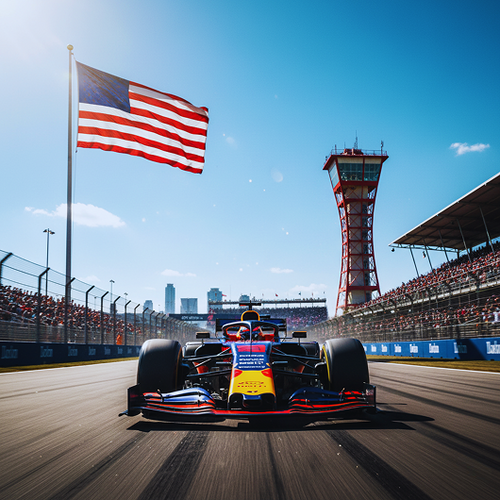
US Grand Prix 2-Day Tickets
The sound of the engines, the odor of burned rubber, and the colorful blur that goes past at impossible speeds make watching Formula 1 in person a completely different — and better — experience than seeing it on a screen. For those who don't want to commit to the full three-day turnout, the 2-Day Pass for Friday and Saturday offers fantastic opportunities to take in the live show and some of the most important moments of Grand Prix weekend, at two-thirds of the price of a full-together ticket.
What do you get with this 2-Day Pass? Well, Saturday's qualifying runs determine the absurdly crucial starting grid that sets up for the main event on Sunday. And the "Paddock Pass" allows you to soak in the atmosphere up close and personal with the teams in the garage area as they fine-tune the cars ahead of the two on-track days. There are "fan zones" everywhere that hum with activity, from the interactive displays to the grid walk. And all of that is just an appetizer in the lead-up to the Sunday race that's the crescendo of this whole Texas Hill Country experience.
US Grand Prix 2026 Information
October 24-25, 2026 at COTA
The 2026 Grand Prix at the Circuit of the Americas continues the storied relationship this venue has had with Formula 1. That relationship was recently extended all the way to 2034; F1 has become a beloved part of the Austin calendar, a city in which the circuit is a permanent fixture and in which the atmosphere for all kinds of motorsport is exhilaratingly singular and American. The weather in Austin in October is also close to perfect, with temperatures usually in the ideal 60s to low 80s (Fahrenheit) and with the kind of low humidity that makes anything else feel like summer. The track also offers an "unbelievable" experience for the people who take part in the race, from drivers to fans.
As the 2-Day Pass offers an entry point to the first two days of racing at the Circuit of the Americas in 2026, let's break down slightly what might happen in terms of both battle for an F1 championship and storylines involving several key drivers during that race weekend. Teams reveal their true competitive trim in the lead-up to each Formula 1 race. This is a sport of subtlety and nuance, and those who are better and cleverer at the art and science of going fast tend to get their cars to the front. After Friday practice, the order of competitiveness is usually well established. If a team is up front, it will likely stay there. If it's back in the pack, it hasn't discovered the right combination of set-up and speed. When things really matter, like for the championship, every position, every half a click of set-up, even where a car is on the grid, can make a huge difference.
The cars then go to qualify on Saturday, which is where things tend to get really interesting. Every driver knows that he must put down a good lap when it counts, and if there are 20 cars on the entry list, then that makes 20 stories to follow. The flavors of the supporting race series: Formula 2 and Formula 3 spotlight the sport's burgeoning talent. The wheel-to-wheel action they deliver is often of the sort that, if it were to occur during the race, would make NASCAR viewers switch back to a channel showing the ACC Basketball Tournament. Those series, in turn, occasionally serve as the opening act for the real entertainment: Porsche Supercup.
Supercup races deliver a high-octane, high-drama precursor to the moment when the green flag signals that 20 Formula 1 cars will be set free to race on a track that is 3.4 miles long and not quite fully contained by the laws of physics — at least, not unless the laws of physics as we understand them are somehow tweaked to favor the unfathomable torque of a Formula 1 engine. This puts you right in the middle of where the action is — start-finish straight excitement, pit stop drama, and victory podium pandemonium all happening right in front of you.
The grandstands at Turn 1 enjoy a front-row seat to what is, in fact, the most uphill approach to a corner in all of motorsports, leading to an extremely tight left-hander. The practice sessions on Friday show us the kinds of lines that different drivers will take; they're really just drivers looking for different ways to make the car go faster. Saturday's qualifying is a fantastic display of what the next day always promises to be — an executed performance at the limit of what's possible. Braking late and accurately for the turn while making sure that the car absolutely rotates right after you've turned in and then back on throttle perfectly are the demands of the act as the driver that you'll see. But also know that this act happens in front of an audience with 12 through 15 being the theater for the car to show balance and for the driver to show precision. All that you saw — and maybe even heard — in this act gets revisited in a different light on Sunday during the race.
Experience world-class Formula 1 live!
The standard service at the airport provides access to rental cars, but most fans opt for ride-share or shuttle services. As the circuit is located such a distance from Austin proper, and traffic demands shuttles, these running from downtown are a much better option than trying to slog through the five-stoplight gauntlet that is Highway 71 en route to the track. Who wants to worry about arriving on time when you can just board a shuttle at a posh downtown hotel and enjoy care-free camaraderie with fellow fans?
Lighting up the Austin streets with ensuing high weekend ticket demand, my pathway to that evening of gorgeous glimpses through guitar-colored gas stations necessitated acquiring two tickets. Public transport doesn't go close enough to the circuit for either option to work well. I needed to travel via one of the two practical options with which I could arrive and depart round-trip over the weekend: shuttles or ride-share. Ticombo takes the worry out of the ticket-buying process — there's no doubt your purchase today will get you through the gate come next October.
Why Buy US Grand Prix 2-Day Tickets on Ticombo
Secure Transactions
A safe online transaction isn't an option — it has to happen. Ticombo is armed with the industry-standard security everyone expects these days, and for good reason. In every transaction and in every interaction, we employ secure channels and encryption to keep your financial information private and render your ticket-buying experience worry-free. We also use an escrow-style system to ensure that your payment isn't released to the seller until you're past the gate with a ticket in your hand. Pay with peace of mind — your information is safe and private, and the transaction is most certainly secure.
Fast Delivery Options
Buyers have more than just ticket delivery on their minds, and rightly so. For international fans, secure and timely delivery is paramount. Ticombo has you covered here, too, with a clear outline of the delivery process, including when to expect your tickets. Some events go the digital route; in those cases, electronic delivery will get you your tickets faster than you can say "get me to the starting line." If your entry comes in the form of a physical ticket, you've got a tracking number for the journey from seller to your hands. And did we mention the no-ambiguity clause? Clear communication is a Ticombo hallmark.
When to buy US Grand Prix 2-Day tickets?
Buying early has several advantages beyond the possibility of getting favorable prices. First, you have access to the full selection of seats, rather than choosing from what's left. Second, you can secure the foundation of your weekend by getting the tickets in hand so that the rest of your plans can revolve around that certainty. And third, you can dodge the accumulating anxiety of watching kinds of tickets you want get snatched up as the concert date nears.
But there's also a good case to be made for buying later. It's about flexibility. It's about information. The later you buy, the clearer picture you have of everything that matters — your own schedule, the weather, the championship situation — which translates into better decision-making. And there's also often a hope for price drops if demand proves soft. That said, with F1 racing, especially at a venue like Austin, you're gambling if you think prices will go down if you wait. Watch the marketplace. Set alerts. Pounce when the conditions seem optimal.
Latest Formula 1 News
George Russell had a good chance, with Mercedes, to qualify for the Las Vegas Grand Prix in first place. My feeling going into qualifying was that if either Russell or his teammate, Lewis Hamilton, were to take pole, it would likely be Russell. With two laps in Q3 that were even better than the times he had set in the earlier parts of qualifying, Russell secured the pole position. It was the first pole for the American team and the first time Russell had become the first man on the grid since last season's Suzuka race.
The significance, however, goes farther than just this weekend. McLaren's resurgence stands as one of the defining narratives of the 2023 season. After two years of rebuiliding, the papaya cars of Fernando Alonso and Lando Norris that are sprinting around the circuits again seem to be in championship contention. Their constructors' title success has been secured through consistent point scoring from both Alonso and Norris.
Frequently Asked Questions
How to purchase US Grand Prix 2-Day tickets?
Choose the tickets you want, check the final price (accounting for whatever fees might apply), and go to the payment screen. Payments process securely through major credit cards and alternative methods (what you can use depends on where you are). Creating an account makes your next purchase easier and lets you keep track of what you've bought. After you've paid, you get the nitty-gritty of the transaction along with the delivery schedule. If you went with etickets, don't expect them too far out from the actual event. And if you got physical tickets, they'll be coming to your house according to the schedule you were given during purchase.
How much are US Grand Prix 2-Day tickets?
Two-day passes cost different amounts depending on where you sit, when you buy, and how much demand there is. On the whole, though, a two-day pass costs less than a single-day ticket for either Saturday or Sunday and gives you more time to watch what's happening on the track. Ticombo's marketplace lets you see all the tickets in one place and all the prices too, which is a good thing because it helps you make an informed decision.
Are US Grand Prix 2-Day tickets transferable?
Numerous contemporary tickets are presented as mobile or digital representations of the ticket, which also contain the linking information of the original purchaser. These digital tickets come with their own graphical user interfaces (GUIs) — some may call them "apps" — that allow the ticket holder to enter the event venue. In some cases, ticket holders need to do little more than make the screen of their smartphone visible to an attendant.
Yet even as event access becomes more app-driven, there are still plenty of events at which physical stubs are "issued."
Seal of Excellence by EU Commission
Ticombo GmbH (parent company) is recognized under Horizon 2020, the EU's research and innovation funding program for its proposal No. 782393.

As seen on the news